
Version 3 · 2026-10-02 · verdict withdrawn
Nyalai has withdrawn its verdict on this submission. No verdict is in force, and no conclusion, positive or negative, is stated on the strategy. The reasons, what is withdrawn and what remains open are set out in correction notice CN-003, after the metadata.
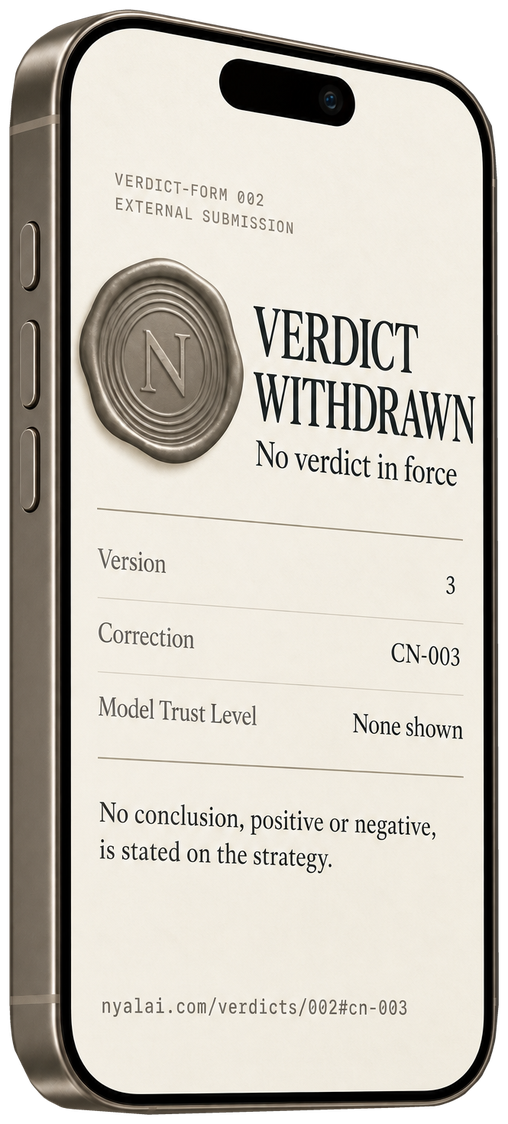
External submission · Refusal Doctrine v0.3.3
Verdict-form 002
Verdict withdrawn · no verdict in force · CN-003
A multi-strategy trading pipeline, submitted by its developer.
The verdict published on 2026-09-28 is withdrawn by correction notice CN-003. No conclusion on the strategy is stated.
Evaluated 2026-07-22 · Ledger N = 223 resolved live trades · Window 2026-04-16 to 2026-06-15
Version 3 · 2026-10-02 · correction notice CN-003 · the version history closes this page
Correction notice CN-003 · full textWhy the verdict is withdrawn, what is withdrawn, what remains open
Correction notice CN-003 · 2026-10-02, 09:34 New York · version 3 · verdict withdrawn
Nyalai withdraws the verdict of this verdict-form, NOT-CALIBRATED, and the attribution of the Model Trust Level MTL-1 made with it. This is a correction of Nyalai's own work. It states no conclusion on the submitted strategy, neither that it succeeds nor that it fails. No verdict is in force for this submission.
Why the verdict is withdrawn. The verdict was justified by three gate results presented as measured failures. None of the three is established as a gate result under the Refusal Doctrine.
- Gate 1a, the Deflated Sharpe Ratio. The deflation the doctrine requires needs the record of the configurations tried during development; the submitter's optimizer discarded that record at the end of its run, as the submitter documented. The evaluation computed the ratio for a single trial, that is without deflation, and found 0.0437 against a threshold of 0.95; with the formula as implemented, a correction for a larger number of trials cannot raise that value. This bound concerns the formula applied to the series of 223 trades pooled across the combinations of the pipeline. Whether that series is the object section 9.1 intends was not established, and the bound is not a Gate 1a result.
- Gate 2, cross-regime robustness. In the sealed text, section 9.2 prescribes regime detection by a Hidden Markov Model, and also accepts discrete states that the submitter specifies in advance, for example rolling percentile buckets on realized volatility. Neither was done: at run time, the validator itself split a rolling volatility of the strategy's own returns into two halves. The two regimes reported are a diagnostic.
- Gate 5, bootstrap confidence. Section 9.5 prescribes a bootstrap of the return series that recomputes the Sharpe ratio on each resample, by blocks when returns are auto-correlated. That bootstrap was not computed in the evaluation. The interval published, [−0.2646, +0.0109], is an interval on the mean per-trade return. It coincides, to the four decimals published, with the mean plus or minus 1.96 standard errors; the records do not establish that it was produced by resampling, and the resampling run on 2026-08-12 gave close but different values, [−0.2639, +0.0106].
Gate 3 was reported as NON-COMPUTABLE: the record its test needs was discarded in the same way, and the test that section 9.3 names was not found in the versions of the validator examined; whether that label fits is left open, as in version 2.1. Three further points. Versions 1 and 2, having reported a failure at Gate 1a, went on to report the later gates, which section 2.3 excludes (“A strategy that fails one gate is not tested at subsequent gates”), without saying so. A synthetic calibration script was used before the evaluation run, but no calibration conforming to section 9.5a was found in the archives examined. And the verdict-form lacked three items that the doctrine requires before publication: the Attestation panel of section 6.6, which states that the submitter's identity and relational information were removed from the package handed to the judge before the gates ran; the annex of known bias sources of section 5.3; and the one-page thesis, which section 9.0 requires to be published with the verdict-form. The absence of the published Attestation panel does not, by itself, establish whether the underlying anonymization procedure was performed. Whether a one-page thesis was submitted before the gates ran is not established in the records examined. The relationship between the submitter and the founder is disclosed below.
What is withdrawn. With the verdict and the attribution of the Model Trust Level: every FAIL shown in the gate table, every statement that gates failed or that failures were measured, and the reading of risk drawn from them. In particular: “Refused on three measured gate failures”; “The verdict here rests on the three measured failures and on nothing else”; “The structural separation the doctrine requires is carried by two mechanisms that operate outside private judgment”; “The applicable gates are executed by a validation package with a versioned commit that does not vary with submitter identity”; “The reported interval comes from independent resampling of the 223 trades”; that the figures of Gate 5 “were recomputed on 2026-08-12 from the per-trade return file”; “the tool would run if the input were supplied, and only the submitter can regenerate it”; “Drawdown risk is measured”; and “Shortfall risk follows”.
What this correction does not say. It does not say that the strategy is calibrated, nor that it is not. The figures computed on the 223 trades stay in the record below as diagnostics, not as gate results. Any future evaluation would need to establish which prescribed tests can be executed, which prerequisites remain unavailable, and whether the doctrine permits a verdict on that basis.
The Model Trust Level. The MTL-1 attribution published with the verdict is withdrawn. This page assigns no replacement level. The general default rule remains unchanged; its application to a submission whose verdict has been withdrawn requires clarification. Version 2.1 announced that this would be settled with the correction; it is not.
How it was done. Section 11.4 of the doctrine provides for a verdict to be withdrawn through a contestation, an objection by the submitter or by an allocator reviewed by a second validator instance, and treats a verdict withdrawn that way as a Nyalai correction. The doctrine has no provision for a withdrawal on Nyalai's own initiative; where it withholds a verdict, as for regimes with too few observations (section 9.2), it does so on other grounds. This withdrawal is Nyalai's own correction, under the correction protocol of this page. Version 2.1 announced that this notice would state the status that the evidence and the doctrine support; the doctrine has no status for a verdict withdrawn this way, and no verdict is in force. Nyalai alone examined its own records; no external technical reader has examined them or this correction. It states no new result about the strategy.
The delay. This page promises a versioned correction within twenty-four hours of a finding. The first finding behind this correction was recorded on 2026-09-29 at 19:45:50 New York at the latest. Version 2.1 is dated 2026-10-01 at 20:45, the time of its commit, and was pushed at 20:49. This correction is dated 2026-10-02, 09:34. The promise was not kept.
The record below. Under the headline and the metadata, down to the correction protocol, the text of version 2 as published on 2026-09-28 and the provisional annotation of version 2.1 are kept unchanged as the record. Version 1 is described in the version history, with correction notice CN-001; its text is kept in Nyalai's records and is not republished here. What is listed above is withdrawn.
Verdict scope statement · Doctrine v0.3.3 § 9.7
A verdict from Nyalai applies only within the scope stated above. Deployment outside this scope requires a new evaluation. Portfolio construction, meaning weighting, correlation, volatility target and rebalancing cadence, is not validated by the five gates; it is the responsibility of the allocator.
Version 2.1 · provisional annotation · 2026-10-01, 20:45 New York · not the correction
This verdict-form is under technical review. Its published status, NOT-CALIBRATED, is unchanged while the review runs. This annotation names the statements of this page that the review concerns. It is not the correction: a versioned correction, notice CN-003, will follow the review and will state the status that the evidence and the requirements of the doctrine support.
Statements not supported by the evidence examined.
- “The applicable gates are executed by a validation package with a versioned commit that does not vary with submitter identity.” This page says further down that “The bootstrap figures are not from that run”, and the CICE methodology page says that the bootstrap of the Sharpe ratio the doctrine specifies is not implemented for return series.
- “The reported interval comes from independent resampling of the 223 trades”, and the figures of Gate 5 “were recomputed on 2026-08-12 from the per-trade return file”. The published interval, [−0.2646, +0.0109], coincides, to the four decimals published, with the analytic interval, the mean plus or minus 1.96 standard errors of the same 223 returns, and first appears beside that standard error in a technical report of July 2026. The resampling run on 2026-08-12 gave close but different values, [−0.2639, +0.0106]. The pieces examined therefore establish neither that the published interval came from a resampling nor that it is the one recomputed on 2026-08-12. It is also an interval on the mean return, while Gate 5 of the doctrine specifies a bootstrap of the Sharpe ratio, and this page does not flag that departure.
- For Gate 3: “the tool would run if the input were supplied, and only the submitter can regenerate it”. The permutation test that section 9.3 of the doctrine names was not found in the versions of the validator examined, and the CICE methodology page says that it is not implemented for return series. Whether NON-COMPUTABLE is the right label for this gate is part of the review.
To be re-examined. The justification of the status by “three measured gate failures”, stated in the subject line and in the sentence “The verdict here rests on the three measured failures and on nothing else.” The review examines each of the three: on which series Gate 1a was computed, whether the regimes of Gate 2 are those the doctrine prescribes, and how the interval of Gate 5 was obtained. The figure of Gate 1a, a Deflated Sharpe Ratio of 0.0437, was computed for a single trial, that is without deflation; with the formula as implemented, applied to this series, no correction for a larger number of trials can raise it above 0.0437. The sentence “Drawdown risk is measured” is also under review: this page reports no drawdown figure.
A question of definition. This page assigns the model trust level MTL-1, whose published definition reads “No independent validation performed.” Whether MTL-1 applies to a system that went through this evaluation is a question of definition, to be settled with the correction.
The delay. This page promises a versioned correction within twenty-four hours of a finding. A review of 2026-09-29, recorded at 19:45 New York at the latest, found that a statement of this page, on the execution of the gates by the validation package, was not supported, and noted the question of MTL-1. No correction was published within twenty-four hours, and the CICE methodology page that contradicts that statement was published on 2026-09-30 while this page was left unchanged. This annotation, published 2026-10-01, 20:45 New York, is not the correction either. The delay is recorded here.
Executive summary
Three gates fail on measurement. The rest is named rather than assumed.
The subject of this Verdict-form is a multi-strategy trading pipeline submitted by the developer who built it. It was evaluated on 223 resolved live trades recorded from 2026-04-16 to 2026-06-15, together with a documented backtest population supplied by the author. Against the applicable gates of the Refusal Doctrine v0.3.3, it is NOT-CALIBRATED, at Model Trust Level MTL-1.
Three gates fail on measured values. The Deflated Sharpe Ratio is 0.0437 against a threshold of 0.95, more than twenty times below the passing bar. Cross-regime robustness returns a negative annualized Sharpe in every regime detected rather than in one, at −6.08 on 112 trades and −3.19 on 111. And the bootstrap confidence interval on the mean per-trade return contains zero under every resampling scheme tested.
Three evidentiary states do not carry the verdict. The corrected p-value that Gate 3 requires is NON-COMPUTABLE, because an input its method needs does not exist. Gate 1b and Gate 4 are NOT APPLICABLE, because the strategy emits no calibrated probability. This Verdict-form names each of the three, says why, and lets none of them stand in for a result.
This matters more than the arithmetic. A validation that reports only what it managed to compute, and stays silent about what it could not, tells a reader that the perimeter was complete when it was not. The verdict here rests on the three measured failures and on nothing else.
Read against the four risk axes an allocator uses, the framework Matt Bank of Global Endowment Management sets out in conversation with Ted Seides on Capital Allocators, the exposure is this. Drawdown risk is measured, and it is the path of returns: the live series over the window is negative, and the bootstrap interval on the mean per-trade return contains zero under every scheme tested. Shortfall risk follows, in his sense of a portfolio's ability to meet a spending stream over time, because a strategy whose expected contribution is not distinguishable from zero erodes that ability rather than supporting it. Liquidity and variance are not assessed here: the first was not measured, and the second depends on an institution's own tolerance for standing behind its peers, which no validator can supply.
Precision of record, 2026-09-28. An earlier state of this paragraph defined shortfall risk as permanent capital loss beyond expected drawdown and attributed that definition to him. It is not his: the framework defines shortfall risk as the probability that a portfolio fails to meet its liability stream over time. The wording above uses his definition. A framework cited by a living person's name is quoted in that person's terms or it is not cited by their name.
Five gates · results and states
Three failures are measured.
One cannot be computed. One does not apply.
Gate 1 bifurcates under Doctrine v0.3.3 section 9.1. Branch 1a, the Deflated Sharpe Ratio, applies to a return-generating system and is the row above. Branch 1b, the Brier Skill Score, applies to a probability emitter and does not apply here. All gate specifications and thresholds are published under Creative Commons Zero at nyalai.com/doctrine.
What could not be computed, and why
An absent input is reported as an absent input.
Gate 3, the corrected p-value. The guided-search-safe permutation test the doctrine specifies requires the per-trial performance of the configurations actually searched during development. That data does not exist. The optimizer created its studies in memory without a storage argument, so every non-selected trial was discarded at the end of the run, which the submitter documented in the same delivery. The value is therefore NON-COMPUTABLE: the tool would run if the input were supplied, and only the submitter can regenerate it, by re-running the search with storage persistence and per-trial logging enabled.
Version 1 of this document also reported the gate result as an inferred failure, drawn from the aggregate Deflated Sharpe Ratio and from the judge calibration. That status is withdrawn. The doctrine gives a gate whose input is absent a status distinct from failure, and the calibration figure published in version 1 did not reproduce. Gate 3 carries one status here, NON-COMPUTABLE, and it does not carry the verdict.
Gates 1b and 4, probabilistic calibration. Both are NOT APPLICABLE, and for one reason: the submitted strategy is fixed-notional and returns a binary enter-or-skip decision rather than a calibrated probability. A calibration test is not defined on an object that emits no probability. These gates were not executed, and an earlier state of this document said that one of them had been. That statement was withdrawn on 2026-09-28 after three measurements established that no such execution occurred.
Why this section exists at all. Two of the five gate slots produce no number, and the probabilistic branch of a third produces none either. A verdict-form that reported only the slots that did would look more complete and would be less true.
Sovereignty rule 7 · relationship disclosure
The submitter is a personal acquaintance of the Nyalai founder.
This is disclosed because the doctrine requires it, not because it was discovered. No shared economic upside exists: the submitted strategy is the submitter's personal research project, with no Nyalai stake, no fee tied to the verdict outcome, and no equity or revenue relationship attached to the submission.
The structural separation the doctrine requires is carried by two mechanisms that operate outside private judgment. The applicable gates are executed by a validation package with a versioned commit that does not vary with submitter identity. The thresholds applied were declared in the doctrine before the ledger was signed.
What the validator does on synthetic strategies, as measured. The test draws synthetic strategies whose edge is known: each trade wins twice the risk or loses the risk, a cost of 0.05 of the risk is deducted per trade, the edge is present in each of three regimes, and one configuration is declared. Each cell was run on at least six seeds, using either 400 or 2,000 draws per cell, and the control on one seed for each. At the validator commit used for this case, the validator accepted 100 percent of the strategies with a per-trade Sharpe of 0.40 at 600 and at 1,200 trades, and between 99.5 and 100 percent at 300 trades. With no edge, acceptance ranged from 2.75 to 4.05 percent across the tested sample sizes and seeds. At a per-trade Sharpe of 0.05, acceptance ranged from 15.30 to 42.35 percent; at 0.10, from 39.8 to 92.0 percent. In a control run against the validator as it stood at commit cice/7259e81, before a repair made on 2026-07-22, no strategy was accepted in any tested cell. Under the code at that commit, a strategy declaring a single configuration could not pass, and the repair removed that failure mode. These results characterize this synthetic test only. The generator holds the edge across all three regimes, and these results do not establish the validator's behavior on real submitted strategies. The measurements are Nyalai's own, so they are independent of this submission and they are not independent of Nyalai.
What the prior record actually is, stated at the level the evidence supports. Before this case the validator had rendered four formal verdicts, in its own sense of an output of the validator: three through the return-strategy gate set, on 2026-06-28 and 2026-06-29, and one through the calibration judge on 2026-07-01. This count is under reconciliation. An earlier state of this document described that record as a reference class of verdicts on independent submissions; that description is withdrawn, because the independence of those submissions is not established. This case is an external submission.
No third-party capital was allocated to this strategy during the evaluation window. No fund entity, advisory vehicle or client-facing product is associated with the submission.
Provenance of the numbers
The figures on this page have three origins, and each is named.
The gate results for statistical fragility and cross-regime robustness, and the population figures, are cited from the run recorded under validator hash cice/f72c4d1: 223 trades, per-trade Sharpe of −0.12, Deflated Sharpe Ratio of 0.043688, and per-regime annualized Sharpe of −6.08 on 112 trades and −3.19 on 111 trades.
The bootstrap figures are not from that run. The confidence interval, the probability of a positive mean, the measured autocorrelation and the moving-block variants were recomputed on 2026-08-12 from the per-trade return file, 223 finite trades. An earlier state of this document stated that every numeric value came from the validator hash, which was not accurate for that gate, and the correction is recorded rather than absorbed.
The figures on synthetic strategies are from neither. They were measured on 2026-09-28 against the validator code at cice/f72c4d1, with a control against cice/7259e81, under two protocols written down before the runs. They describe the validator and not the submitted strategy.
Under Rule C of the validator's own canon, a verdict names the validator code commit and the validator run commit as two fields. Here they are the same commit, because the run followed the merge by five minutes on the same machine. They are stated separately anyway, because a reader is entitled to see that the question was asked.
The resampling scheme is stated rather than implied. The reported interval comes from independent resampling of the 223 trades. A moving-block variant at fixed block lengths of five, ten and twenty is reported alongside it as a robustness check, and the interval contains zero under every specification tested.
Correction protocol
If a claim here is wrong, it is corrected in public within twenty-four hours.
If any claim in this Verdict-form is found to be incorrect, Nyalai publishes a versioned correction within twenty-four hours of the finding, with a public changelog. Errors acknowledged become credibility signals. Errors hidden become credibility risks.
This document is published under Creative Commons Zero. The methodology is at nyalai.com/methodology/cice and the doctrine at nyalai.com/doctrine, both public. The synthetic measurements summarized above are recorded with their pre-registrations and their outputs, and are not published; a reader who wants them may ask.
Version history
Version 1 · 2026-09-28. First publication. Earlier the same day the page was briefly publicly accessible before consent to the frozen publication artifact had been completed. It was removed and republished after consent. Where the body refers to an earlier state of this document, it refers to drafts that were never published.
Correction notice CN-001 · 2026-09-28. Version 1 stated that the validator returns a passing verdict on roughly 73 percent of synthetic strategies at a per-trade Sharpe of 0.40 and a sample of 600 trades or more, and drew from it that the validator discriminates rather than refusing by construction. That figure did not reproduce at the validator commit used for this case. A notice placed above the text withdrew the statement and its conclusion, placed under review the inferred status of Gate 3, which cited the same calibration, stated that the verdict was unchanged, and announced a corrected version. The header was marked, and the text under the notice was left as published.
Version 2 · 2026-09-28. The notice leaves the top of the page and is recorded here. The withdrawn statement is replaced by what was measured on synthetic strategies, without a conclusion, and is no longer counted among the mechanisms of structural separation, now two. Gate 3 carries the single status NON-COMPUTABLE in place of an inferred failure, in the summary, the heading, the gate table, the section on what could not be computed and the provenance section, which also names a third origin. The sentence offering a calibration table names what is recorded. One emphasis that printed as asterisks is rendered. The version is shown under the headline and in the header. The verdict, the Model Trust Level, the three measured failures and every measured value about the submitted strategy are unchanged.
Version 2.1 · 2026-10-01. A provisional annotation is added to the page, announced by a short notice at the top. It leaves the body of version 2 unchanged and is not the final correction: it names the statements under technical review and records the delay. The final correction, notice CN-003, will follow the review.
Correction notice CN-003 and version 3 · 2026-10-02. The verdict NOT-CALIBRATED and the attribution of the Model Trust Level MTL-1 are withdrawn, as a correction of Nyalai's own work, with no conclusion on the strategy, and no level is shown. A short notice at the top of the page states the withdrawal and links to the full notice CN-003, placed after the metadata, which lists what is withdrawn and replaces the short notice of version 2.1. The heading, the status line, the metadata, the header and the description of the page say that no verdict is in force; the subject line no longer reads “Refused on three measured gate failures.”, and an image of the status replaces the seal at the top. The text of version 2 and the annotation of version 2.1 are kept, unchanged, as the record. The doctrine page of this site, which omitted the condition that the submitter specifies states in advance, is aligned with the sealed text in the same publication.
A verdict from Nyalai is not an endorsement of anything, and a refusal is not a statement about the competence or the intent of the person who submitted. It is a statement about what the evidence supplied permits a reader to conclude.